
Serial 2 S Complementer Shift Register
I know this question has been asked and there already are answers to this question on the Internet. I just want to ask you where I am wrong in my way of thinking. When I first saw this question, the shortcut -keep copying until you see a 1 and then complement the rest- hadn't occurred to me. So I thought I would just complement the bit, add 1 to it and if I get a carry then I would keep it in the flip flop to add it to the next bit coming from the input. Meaning that, In State-0 if the input is 0 then I should output '0' (after complementing) and keep that carry '1' in the flip-flop so flip-flop goes from state-0 to state-1. If the input is 1 then I should output '1' but the flip-flop remains in the same state which is state-0. In State-1 if the input is 0 then I should output '1' -since 2's complement would be 10 and I have a carry '1' in the flip-flop- I would get another carry so the state remains the same.
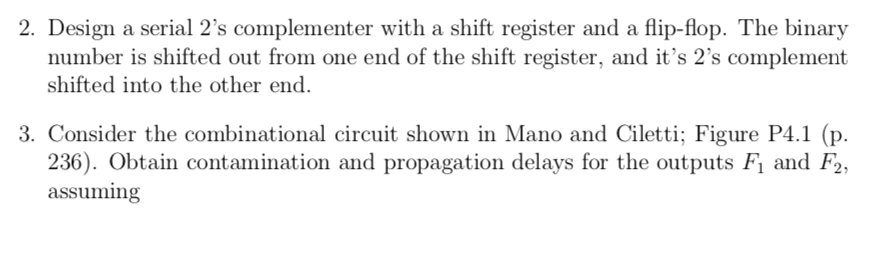
Design a serial 2's complementer using this procedure. The circuit needs a shift register to store the binary number and an SR flip flop to be set when the first least significant 1 occurs. An XOR gate can be used to transfer the unchanged bits (x[xor]0=x) or complement the bits (x[xor]1=x'). Apr 29, 2010 Design a serial 2's complementer using this procedure. The circuit needs a shift register to store the binary number and an SR flip flop to be set when the first least significant 1 occurs. An XOR gate can be used to transfer the unchanged bits (x[xor]0=x) or complement the bits (x[xor]1=x').
If the input is 1 then I should output '0' and the flip-flop remains in the same state as well. Here is my state diagram: +---------+-------+-------+--------+ Present Next State Input State Output A x A y 0 0 1 0 0 1 0 1 1 0 1 1 1 1 1 0 +---------+-------+-------+--------+ After getting the equations from the table above. I get a circuit like so: – Schematic created using Can you please help me to figure out what's wrong with my way of thinking? Thank you in advance.:). I just figured out the problem and here I am explaining. If you were trying to solve this problem the same way I was trying (without thinking about the shortcut like 'output the same value till you see a bit of value 1 and then complement others in the string.' ) then we will have 2 states.
State-1 (Initial State - Carry-1 State) Which we have a carry-1 to add to the least significant bit of the string after complementing. Because that's what you would normally do when you are trying to get the 2's complement of a bit string. You just complement the entire string and add 1 to the least significant bit. You could name this state, State-0 as well but I am just naming it State-1 not to get confused.
Greg Jackson (born 1974). In 2009, Jackson released an instructional book about his fighting style called Jackson's MMA - The Stand Up Game. Greg jackson stand up game pdf download.
So that I know I have a carry 1 in the flip-flop. Tabledit torrent crack keys full. State-0 (Which signifies that you don't have any carry left) This state means that you have no carry left in hand. So you just complement the bit at the input.
Let's inspect what possibilities we can get when trying to get the 2's complement of a bit string. • In the initial state you could get a 1 whose 1's complement is 0 and with a carry in hand equals to 1. Since that sum doesn't generate a carry. You have no carry left in hand and you go to State-0. • Again in the initial state you could get a 0 whose 1's complement is 1 and with a carry in hand this sum equals to 10, which means you will again have a carry in hand and therefore remain in the same state which is State-1. But the output will be 0.
• In State-0 you could get a 0 again and since you don't have any carry in hand you just output the 1's complement of 0 which is equal to 1. • Again in State-0 you could have 1 at the input and since you don't have any carry your output would be equal to 0.
Having that said, we draw a state table as follows: +---------+-------+-------+--------+ Present Next State Input State Output A x A y 1 0 1 0 1 1 0 1 0 0 0 1 0 1 0 0 +---------+-------+-------+--------+ Looking at the table, we get a state diagram like so: Then we get this circuit: – Schematic created using.
Just to be fair, this is a previous exam question and was an assignment question. I've already handed in the assignment and now I'm trying to see why I got it wrong -- to study for my final. I fully understand how to find the 2's complement of a binary number, however, implementing a circuit to find the complement is driving me crazy. I'm given a shift register (that stores my binary number) and a flip flop (using D for simplicity). The process I follow for building sequential circuits is this: • I look at the question and derive a state diagram. • From the state diagram, I draw a state table and find the input of my flip flops • I use maps and stuff to finally build the circuit. I'm trying to visualize how to actually draw the state diagram for this complementer.